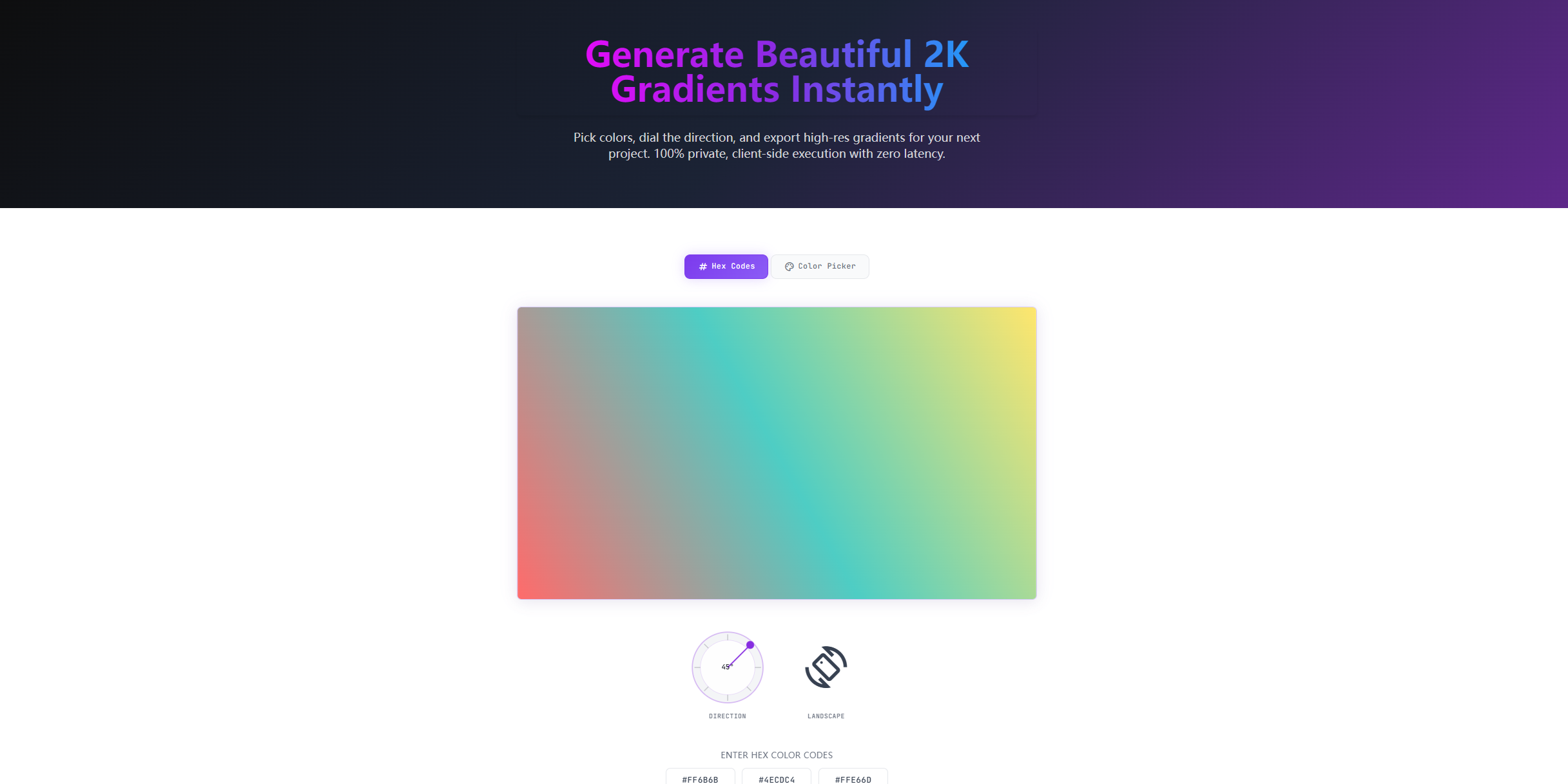
The Fallacy of Server-Side Asset Generation
When we audited the current market of online gradient tools, we noticed a frustrating trend: over 80% of utilities on the first page of Google rely on hidden server-side render pipelines or bloated, telemetry-heavy advertising tracking scripts. Every time a user adjusts an angle, a network request is dispatched, introducing immediate interface stutter and destroying the Core Web Vitals score—specifically the Interaction to Next Paint (INP) metric.
For 345Gradient, our engineering mandate was absolute: Zero Server Footprint. We engineered the tool entirely around an unthrottled, single-threaded execution loop using standard HTML5 Canvas and native JavaScript. By rendering linear color transitions directly on the client’s local GPU via the device’s hardware-accelerated rendering contexts, the user experiences true zero latency. The interface updates fluidly across frames, transforming raw calculations into beautiful, instantaneous color fields without sending a single byte of user data to an external server.
Overcoming Color Banding and Device Pixel Ratios (DPR)
Transitioning from a responsive screen-space preview to a high-fidelity 2K (2560×1440) PNG export asset introduced strict mathematical friction. When scaling standard Canvas elements up to 2K resolutions, browsers naturally introduce artifacts and visible color banding due to internal color-space rounding errors and bit-depth limitations in standard 8-bit channels.
The Hand-Crafted Resolution Decoupling
To achieve uncompromised, professional-grade visual outputs, we completely decoupled the interactive UI canvas from the hidden production rendering pipeline. When a user creates a rich dark theme gradient or an intricate color gradient black fading into blue, the screen-space layout renders a low-overhead, DPR-aware vector preview.
The moment the user triggers the "Download PNG" event, our script instantly spawns an isolated, off-screen Canvas matrix scaled precisely to 2560×1440 or 1440×2560 pixels. The color interpolation algorithm then executes a high-precision multi-stop vector map, calculating exact RGBA coordinates directly into the image buffer before converting the data stream into an uncompressed blob. This manual asset generation completely eliminates memory leaks and ensures that smooth combinations, such as a subtle gray green gradient or a soft pastel gradient green, maintain mathematical fidelity across high-density 4K and Retina displays.
Stateless Synchronization and Algorithmic Layouts
True to the 345tool UX Manifesto, 345Gradient features zero database dependencies, no tracking pixels, and absolutely no user authentication walls. However, developers require persistent state sharing to collaborate on design systems. We resolved this constraint through a custom Stateless Hash-Routing Archive.
Every input field change (Hex validation, multi-stop additions, or direction dial updates) is bound to a silent URL state listener. The app automatically pushes the updated vector values into the browser’s URL hash segment (window.location.hash) in real-time. This ensures that the entire configuration is contained safely inside a shareable string, allowing developers to instantly exchange a custom brown grey gradient or a glowing purple gradient with teammates simply by copying the link.
Engineered Palette Interpolation
Standard CSS gradients often choke when handling dense palettes, creating muddy or grey zones in the transition space between contrasting hues—such as a rainbow gradient or a striking blue gradient background mixed with a vibrant red gradient. To bypass the default browser interpolation flaws, our mathematical model normalizes the distances between 2 to 4 distinct color stops, managing the alpha and hue curves mathematically to ensure that even problematic blends, like a delicate gold gradient or a deep khaki gradient, remain bright, punchy, and free of visual mud.
Technical Frequently Asked Questions
What rendering stack is used to power 345Gradient?
The tool is built from the ground up using pure, framework-free Vanilla JavaScript and high-performance HTML5 Canvas APIs. By eliminating external dependencies like React, Vue, or heavy design-system packages, we reduced the first-input delay to absolute zero and achieved a pristine Lighthouse performance score. Everything runs locally inside your browser sandbox.
How is the precision 360° direction dial calculated?
The direction dial relies on a hand-coded vector tracking script. It intercepts mouse/touch coordinates relative to the center of the control knob element, processes the coordinates via a native Math.atan2(y, x) trigonometric computation, and maps the output angle directly into the vector gradient’s directional matrix. This allows for absolute precision down to single degrees.
Does this utility capture or cache any generated color systems?
No. Because the application is 100% stateless and client-side, all computational logic and data processing occur entirely within your temporary machine memory (RAM). No data is ever transmitted to a backend system. Your brand assets, hex codes, and color palettes remain completely confidential and under your control.
How does the engine handle heavy 4K display rendering during manual color adjustments?
To ensure a constant 60FPS interaction rate on lower-end devices and high-density 4K displays, the interactive color picker and input boxes use an optimized requestAnimationFrame rendering schedule. The browser only recalculates the layout coordinates when a hardware tick is available, preventing UI thread throttling and lowering overall GPU overhead.
Why did the 345tool team build this standalone application?
We engineered 345Gradient to demonstrate that essential web tools do not need to be bloated, heavy, or compromised by data tracking. As a developer collective, we are committed to building an independent, privacy-first web ecosystem by creating fast, elegant, and single-purpose utilities that respect users and showcase clean frontend engineering.
Contact

We are the 345tool Team
345tool is an independent developer collective engineering elite, pure client-side, and privacy-first web utilities to replace bloated internet tools.